
As the global energy transition accelerates and distributed PV adoption continues to surge, deploying microgrids and energy storage systems (ESS) has become a clear consensus among businesses—whether for industrial parks, overseas farms, logistics hubs, commercial hotels, or communities—to optimize electricity costs and ensure power continuity. However, for frontline PV equipment distributors, installers, and EPCs, executing commercial & industrial (C&I) energy storage projects is far more complex than it sounds.
Project timeline delays, strict site safety requirements from business owners, and grid topology compatibility—these are often the three “hidden bottlenecks” that determine whether a project succeeds or fails.
1. How to Solve the Hidden Costs of System Integration?
On traditional C&I energy storage project sites, installers frequently face a major headaches: core components like battery enclosures, Power Conversion Systems (PCS), Energy Management Systems (EMS), and fire safety or HVAC controls are all sourced from different manufacturers.
This piecemeal, “frankenstein” approach requires substantial site labor for wiring and communication debugging. Even worse, interface incompatibilities can cause delivery schedules to drag on indefinitely. For capital-intensive C&I projects, a single week of delay directly impacts the overall Return on Investment (ROI).
To overcome this, the C&I energy storage industry is shifting rapidly toward fully integrated, turnkey solutions.
Pre-integrating batteries, PCS, EMS, BMS, local HMI displays, STS, and DC modules right at the factory to deliver a standard plug-and-play experience has become the key to efficient project delivery.
This all-in-one design directly cuts down on-site installation and commissioning time, allowing seamless grid or PV coupling at the output side. More importantly, to accommodate future load growth, the system must offer flexible scalability. Whether the site requires 2-hour, 4-hour, or 8-hour backup, smooth expansion can be achieved through simple multi-cabinet paralleling—giving EPCs plenty of room to adapt project plans down the line.
2. How to Avoid the Friction of Frequent Equipment Selection?
C&I application scenarios are highly diverse: a farm might need protection against harsh outdoor dust, an island resort requires reliable off-grid operation, while heavy industrial users prioritize efficient peak shaving and load shifting.
Re-evaluating equipment and technical proposals for every new scenario or grid connection mode creates immense technical overhead and communication friction for distributors and installers.
The core competitiveness of a truly mature C&I storage solution lies in its versatility and topological flexibility—one solution to fit all scenarios.
- Topology Compatibility: Natively supports on-grid, off-grid, and hybrid architectures, seamlessly integrating with existing site PV or diesel generator systems.
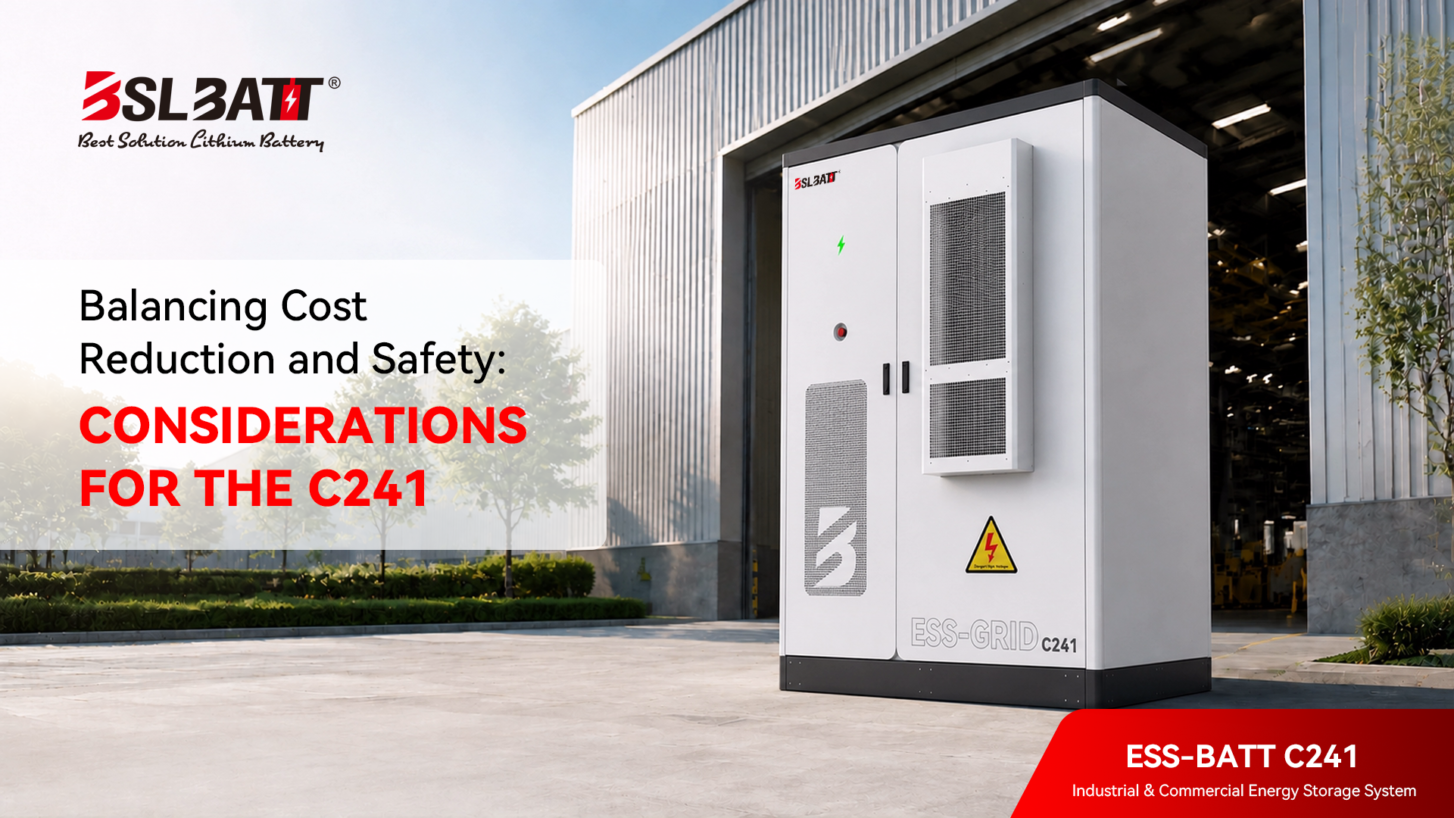
- Space & Power Density: Powered by 314Ah / 280Ah high-capacity Grade-A+ cells, delivering up to 241 kWh of energy within a compact footprint of $1850 \times 1430 \times 2300\text{ mm}$, significantly saving valuable site space.
3. The Bottom Line: Safety and Smart O&M
For any enterprise owner, long-term asset security and steady operational returns will always outweigh short-term visible gains. C&I energy storage systems are typically placed right next to factories, warehouses, or commercial buildings, meaning thermal runaway or fault hazards are risks no one can afford. In traditional all-in-one cabinets, a localized thermal event can easily spread to nearby electrical controls.
Modern advanced engineering solves this with a physically isolated dual-compartment design. By separating the battery compartment from the electrical unit inside the cabinet, the battery section remains completely safe and protected, even if high-voltage electrical components experience extreme fault conditions.
At the same time, a multi-dimensional environmental sensing array ensures potential hazards are caught and stopped right at the start.
Beyond hardware protection, intelligent O&M is where top-tier systems stand out. Traditional maintenance relies heavily on manual, periodic inspections—making troubleshooting feel like opening a blind box.
Featuring cells rated for over 6,000 cycles and a 10+ year design life, the system lets operators monitor status, control battery protection, and adjust SOC parameters in real time via a Cloud Platform and intuitive HMI interface. This transforms C&I energy storage from a “high-maintenance asset” into a hassle-free productivity engine.
Why Do Global B2B Decision-Makers Choose BSLBATT?
In the long marathon of clean energy development, overseas PV distributors and EPCs value long-term compliance, reliability, and certainty above all else.
As a dedicated brand in energy storage, BSLBATT not only offers the all-in-one ESS-GRID C241 system for C&I applications across multiple capacities (from 200 kWh to 241 kWh), but also delivers industry-leading compliance and qualification credentials.
The product line is fully certified under major international standards, including IEC62619, IEC62477 (Electrical Safety), IEC61000 (EMC), and IEC62116 (Anti-islanding). Every refined parameter and compatible topology is designed to ensure fast customs clearance, smooth grid interconnection, and a decade or more of worry-free power security for project owners.
Streamline your next C&I asset delivery. If you are seeking a safer, easier-to-deploy solution for a new microgrid or a C&I solar-plus-storage retrofit project, visit the official BSLBATT website or connect with our solution experts on LinkedIn to get custom topology designs and technical whitepapers.