
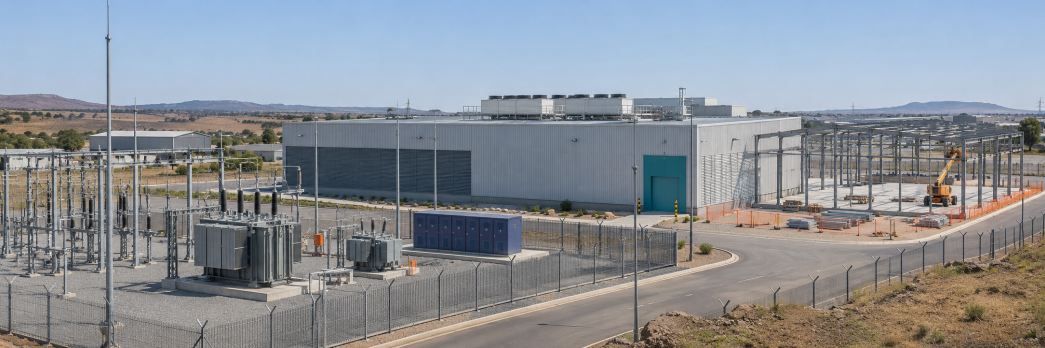
New research examines where Africa’s growing data-centre electricity demand will translate into contracted power sales across eight markets.
Africa’s data-centre electricity consumption is projected to rise nearly fivefold over the next decade, climbing from 2.55 terawatt-hours (TWh) in 2025 to 6.95 TWh in 2030 and 12.60 TWh by 2035 in the base case. Yet the commercial opportunity for power developers and infrastructure investors will depend on tenant uptake and existing supply contracts at individual campuses rather than headline load growth, according to the Africa Data Centre Power Outlook, a new report from energy market intelligence provider Electron Intelligence.
Cloud adoption, enterprise digitisation, and local data-hosting requirements are lifting average facility power demand across Africa from 291 MW in 2025 to 1,438 MW by 2035, while the combined peak duty across individual sites reaches 1,598 MW. That growth creates demand for dispatchable generation, wheeled renewable power, grid interconnections, and backup systems, but announced data-centre capacity does not automatically represent electricity volume available to independent power producers (IPPs).
South Africa accounts for 77% (7.77 TWh) of the continent’s projected demand increase through 2035, while colocation operators carry roughly 90% of forecast growth. Only 337 MW (52%) of Africa’s 647 MW announced additional IT pipeline currently has a scheduled commissioning date by 2035. Even with those scheduled additions, Africa requires a further 583 MW of unannounced IT capacity by 2035 to meet base-case demand. Roughly 513 MW of that deficit sits in South Africa, whereas Kenya’s identified pipeline already exceeds its 2035 forecast requirement.
“Announced IT megawatts are a poor guide to near-term electricity sales,” said David Oni, Head of Research at Electron Intelligence. “In 2025, average IT draw across operating facilities is less than half of installed IT capacity, so immediate load growth will come from tenants filling existing data halls rather than new shells. Because colocation facilities account for nearly nine-tenths of continental demand growth through 2035, power developers and lenders must underwrite signed tenant commitments and actual rack loading rather than master-planned campus capacity.”
The economics of powering Africa’s digital expansion
Because data centres require continuous electricity supply, procurement decisions are determined by delivered power cost across the facility rather than standalone generation cost. Using a standard 12 MW IT facility consuming 97 GWh annually, Electron Intelligence modelled the delivered cost of power across different supply arrangements.
In South Africa, supplementing utility supply and on-site backup with wheeled solar reduces modelled electricity costs by 11.5%, from $126.78/MWh to $112.19/MWh, saving approximately $1.42 million per year. In Nigeria, a 10-year levelised generation model shows standalone natural gas ($144/MWh for pipeline gas and $172/MWh for compressed natural gas) reduces generation costs by 65–71% compared with continuous diesel generation at $496/MWh. Adding a full-sized diesel backup plant brings all-in gas-based costs to $200–$228/MWh, a 54–60% reduction below continuous diesel. Where electricity accounts for 40% of data-centre operating expenditure (OPEX), replacing continuous diesel with natural gas reduces total facility OPEX by 26.1–28.4%.
“Comparing power options on capital cost alone understates the operational and contractual requirements of maintaining continuous data-centre operations,” said Oseiwe, Consultant at Electron Intelligence. “In Nigeria, moving from continuous diesel to gas with diesel backup cuts delivered power costs by more than half, but project viability still depends on gas delivery infrastructure, facility utilisation, and whether a project falls under state or federal electricity licensing in Lagos and Ogun. In South Africa, Kenya, Egypt, and Morocco, the commercial case turns on municipal wheeling rules, transmission-use charges, and off-peak industrial tariff structures.”
A growing market, but not every opportunity is investable
The report also examines the financial exposure of committing power capital ahead of confirmed customer demand. Under Electron Intelligence’s delayed-growth scenario, Africa’s data-centre electricity consumption reaches 6.44 TWh in 2035, 49% below the 12.60 TWh base case. Over 2026–2035, the cumulative difference between the base and delayed pathways reaches 26.6 TWh, with roughly 80% of the shortfall occurring after 2030.
“The primary risk for power investors is committing capital before electricity revenue is secured, particularly where high-voltage substations, transmission connections, or gas pipelines cannot be built in small increments,” Oni said. “When upfront shared infrastructure is required, first-phase contracts need minimum purchase obligations, termination protections, or grid-wheeled remarketing options so developers are not left carrying underutilised assets if tenant occupancy lags.”
The Africa Data Centre Power Outlook combines demand forecasting, power procurement records across 177 operating and 29 planned facilities, 10-year LCOE and OPEX models, 2026 industrial tariff benchmarks, and project-level assessments across South Africa, Nigeria, Kenya, Egypt, Morocco, Angola, Côte d’Ivoire, and Ghana.
For more information, visit the Africa Data Centre Power Outlook page.
About Electron Intelligence
Electron Intelligence is an energy market intelligence and research provider covering Africa’s power and clean energy economy. The platform delivers proprietary asset and transaction datasets, electricity tariff benchmarks, regulatory analysis, and bottom-up financial modelling across generation, grid infrastructure, and commercial power offtake. Developers, infrastructure investors, lenders, and corporate energy buyers use Electron Intelligence to evaluate markets, structure power purchase agreements, and underwrite energy investments across Africa.
Media enquiries
Electron Intelligence
Email: info@electronintel.io | Website: www.electronintel.io